How to Do You Know if a Piecewise Function Is Continuous or Not
Let'south consider a specific example of temperature in terms of date and location, such equally June 27, 2013, in Phoenix, AZ. The graph in Figure 1 indicates that, at ii a.m., the temperature was [latex]{96}^{\circ }\text{F}[/latex] . By 2 p.yard. the temperature had risen to [latex]{116}^{\circ }\text{F,}[/latex] and by 4 p.m. it was [latex]{118}^{\circ }\text{F}\text{.}[/latex] Sometime betwixt two a.m. and four p.m., the temperature outside must have been exactly [latex]{110.five}^{\circ }\text{F}\text{.}[/latex] In fact, whatsoever temperature between [latex]{96}^{\circ }\text{F}[/latex] and [latex]{118}^{\circ }\text{F}[/latex] occurred at some indicate that twenty-four hour period. This means all existent numbers in the output betwixt [latex]{96}^{\circ }\text{F}[/latex] and [latex]{118}^{\circ }\text{F}[/latex] are generated at some point by the office co-ordinate to the intermediate value theorem,
Look again at Figure ane. There are no breaks in the function'southward graph for this 24-hour menstruation. At no indicate did the temperature cease to exist, nor was there a point at which the temperature jumped instantaneously by several degrees. A part that has no holes or breaks in its graph is known every bit a continuous office. Temperature as a function of time is an instance of a continuous part.
If temperature represents a continuous role, what kind of part would not be continuous? Consider an example of dollars expressed as a function of hours of parking. Let's create the function [latex]D[/latex], where [latex]D\left(ten\right)[/latex] is the output representing price in dollars for parking [latex]x[/latex] number of hours.
Suppose a parking garage charges $4.00 per hour or fraction of an 60 minutes, with a $25 per day maximum charge. Park for two hours and v minutes and the charge is $12. Park an additional hour and the accuse is $16. We tin can never be charged $xiii, $14, or $xv. In that location are existent numbers between 12 and 16 that the role never outputs. At that place are breaks in the function'due south graph for this 24-hr period, points at which the price of parking jumps instantaneously by several dollars.
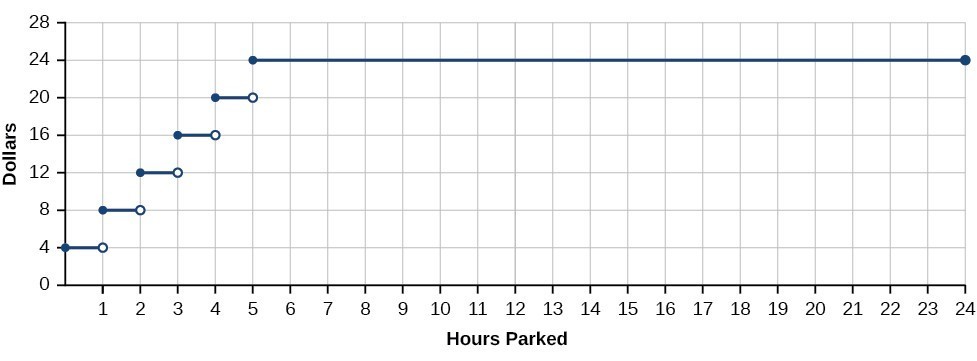
Effigy 2. Parking-garage charges form a discontinuous role.
A function that remains level for an interval and and then jumps instantaneously to a college value is chosen a stepwise function. This function is an example.
A function that has any hole or intermission in its graph is known as a discontinuous office. A stepwise function, such every bit parking-garage charges equally a function of hours parked, is an case of a discontinuous part.
So how can nosotros decide if a part is continuous at a particular number? We tin check three different conditions. Allow's utilise the function [latex]y=f\left(x\right)[/latex] represented in Effigy 3 every bit an example.
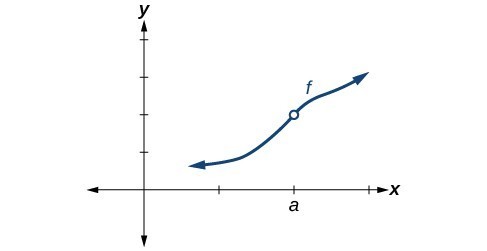
Figure three
Condition 1 According to Condition 1, the office [latex]f\left(a\right)[/latex] defined at [latex]x=a[/latex] must exist. In other words, at that place is a y-coordinate at [latex]x=a[/latex] as in Effigy 4.
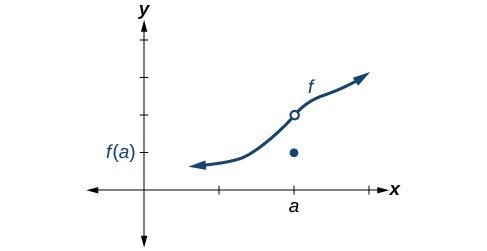
Effigy 4
Status 2 According to Status ii, at [latex]x=a[/latex] the limit, written [latex]\underset{x\to a}{\mathrm{lim}}f\left(ten\right)[/latex], must exist. This ways that at [latex]10=a[/latex] the left-hand limit must equal the right-hand limit. Notice equally the graph of [latex]f[/latex] in Figure 3 approaches [latex]10=a[/latex] from the left and correct, the same y-coordinate is approached. Therefore, Status two is satisfied. Withal, at that place could still be a hole in the graph at [latex]x=a[/latex] .
Condition 3 Co-ordinate to Condition 3, the respective [latex]y[/latex] coordinate at [latex]x=a[/latex] fills in the hole in the graph of [latex]f[/latex]. This is written [latex]\underset{10\to a}{\mathrm{lim}}f\left(x\right)=f\left(a\correct)[/latex].
Satisfying all three conditions ways that the function is continuous. All iii conditions are satisfied for the function represented in Figure 5 so the role is continuous as [latex]10=a[/latex].
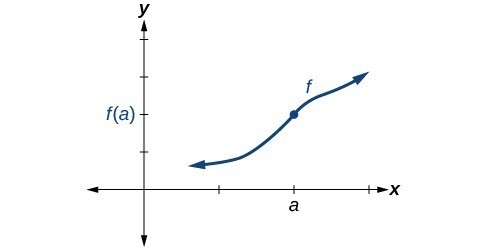
Effigy 5. All iii conditions are satisfied. The function is continuous at [latex]x=a[/latex] .
Figure 6 through Figure 9 provide several examples of graphs of functions that are not continuous at [latex]10=a[/latex] and the condition or conditions that fail.
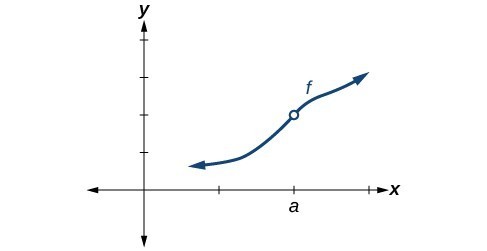
Effigy 6. Condition ii is satisfied. Weather 1 and 3 both fail.
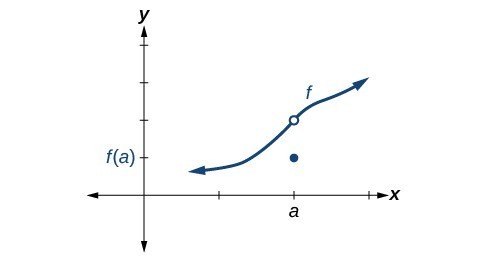
Figure 7. Conditions one and 2 are both satisfied. Status iii fails.
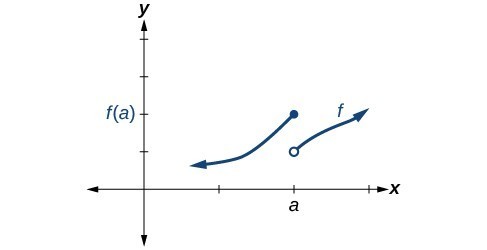
Effigy viii. Condition 1 is satisfied. Weather 2 and iii fail.
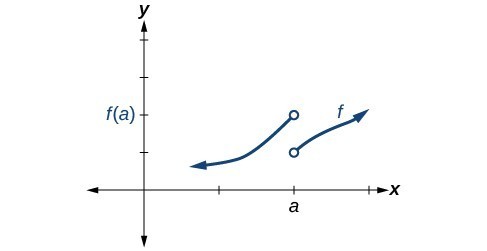
Effigy 9. Conditions i, ii, and 3 all fail.
A General Note: Definition of Continuity
A office [latex]f\left(x\right)[/latex] is continuous at [latex]x=a[/latex] provided all three of the post-obit conditions hold true:
Condition 1: [latex]f\left(a\correct)[/latex] exists.
Condition two: [latex]\underset{x\to a}{\mathrm{lim}}f\left(10\correct)[/latex] exists at [latex]10=a[/latex] .
Condition 3: [latex]\underset{x\to a}{\mathrm{lim}}f\left(x\right)=f\left(a\right)[/latex] .
If a function [latex]f\left(x\right)[/latex] is not continuous at [latex]10=a[/latex], the function is discontinuous at [latex]x=a[/latex] .
Identifying Discontinuities
Aperture can occur in unlike ways. We saw in the previous department that a role could have a left-mitt limit and a right-hand limit even if they are not equal. If the left- and right-hand limits be only are unlike, the graph "jumps" at [latex]x=a[/latex] . The function is said to take a jump discontinuity.
Every bit an example, expect at the graph of the function [latex]y=f\left(x\right)[/latex] in Effigy 10. Notice as [latex]ten[/latex] approaches [latex]a[/latex] how the output approaches different values from the left and from the right.
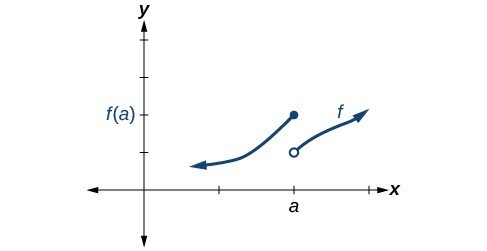
Figure x. Graph of a part with a leap discontinuity.
A General Note: Jump Aperture
A role [latex]f\left(x\right)[/latex] has a jump discontinuity at [latex]x=a[/latex] if the left- and right-hand limits both exist merely are not equal: [latex]\underset{x\to {a}^{-}}{\mathrm{lim}}f\left(10\right)\ne \underset{x\to {a}^{+}}{\mathrm{lim}}f\left(ten\right)[/latex] .
Identifying Removable Aperture
Some functions accept a discontinuity, but it is possible to redefine the function at that indicate to make it continuous. This type of function is said to take a removable discontinuity. Let'south look at the function [latex]y=f\left(x\right)[/latex] represented by the graph in Figure 11. The function has a limit. However, there is a pigsty at [latex]x=a[/latex] . The hole can be filled past extending the domain to include the input [latex]ten=a[/latex] and defining the corresponding output of the function at that value as the limit of the office at [latex]x=a[/latex] .
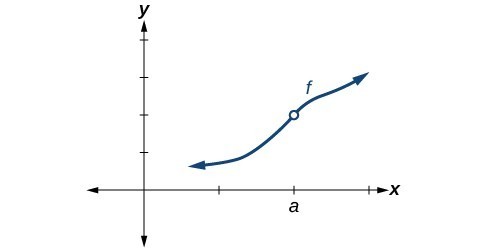
Effigy 11. Graph of function [latex]f[/latex] with a removable aperture at [latex]ten=a[/latex] .
A General Note: Removable Discontinuity
A function [latex]f\left(10\correct)[/latex] has a removable discontinuity at [latex]x=a[/latex] if the limit, [latex]\underset{x\to a}{\mathrm{lim}}f\left(x\right)[/latex], exists, only either
- [latex]f\left(a\right)[/latex] does not be or
- [latex]f\left(a\correct)[/latex], the value of the office at [latex]ten=a[/latex] does not equal the limit, [latex]f\left(a\right)\ne \underset{x\to a}{\mathrm{lim}}f\left(x\right)[/latex].
Case 1: Identifying Discontinuities
Identify all discontinuities for the following functions as either a jump or a removable aperture.
- [latex]f\left(x\correct)=\frac{{x}^{2}-2x - 15}{x - 5}[/latex]
- [latex]g\left(ten\right)=\begin{cases}ten+one, \hfill& ten<ii \\ -x, \hfill& x\geq2\end{cases}[/latex]
Solution
- Notice that the function is defined everywhere except at [latex]x=v[/latex].Thus, [latex]f\left(5\right)[/latex] does not be, Condition 2 is non satisfied. Since Condition 1 is satisfied, the limit as [latex]x[/latex] approaches five is eight, and Status 2 is not satisfied.This ways there is a removable discontinuity at [latex]x=5[/latex].
- Condition 2 is satisfied because [latex]m\left(two\right)=-ii[/latex].Notice that the part is a piecewise function, and for each piece, the office is defined everywhere on its domain. Let'southward examine Condition i by determining the left- and right-hand limits as [latex]x[/latex] approaches ii.Left-hand limit: [latex]\underset{x\to {2}^{-}}{\mathrm{lim}}\left(x+1\right)=2+i=3[/latex]. The left-hand limit exists.Correct-hand limit: [latex]\underset{x\to {ii}^{+}}{\mathrm{lim}}\left(-x\right)=-ii[/latex]. The correct-hand limit exists. But
[latex]\underset{x\to {2}^{-}}{\mathrm{lim}}f\left(10\correct)\ne \underset{x\to {2}^{+}}{\mathrm{lim}}f\left(ten\right)[/latex].
So, [latex]\underset{x\to ii}{\mathrm{lim}}f\left(x\right)[/latex] does not exist, and Status two fails: In that location is no removable discontinuity. However, since both left- and correct-manus limits exist but are not equal, the conditions are satisfied for a leap discontinuity at [latex]x=ii[/latex].
Try Information technology one
Identify all discontinuities for the post-obit functions as either a jump or a removable discontinuity.
a. [latex]f\left(10\right)=\frac{{ten}^{2}-6x}{x - 6}[/latex]
b. [latex]g\left(10\right)=\brainstorm{cases}\sqrt{x}, \hfill& 0\leq x<4 \\ 2x, \hfill& x\geq4\end{cases}[/latex]
Solution
Recognizing Continuous and Discontinuous Real-Number Functions
Many of the functions we have encountered in earlier capacity are continuous everywhere. They never have a hole in them, and they never leap from one value to the next. For all of these functions, the limit of [latex]f\left(x\correct)[/latex] every bit [latex]x[/latex] approaches [latex]a[/latex] is the same as the value of [latex]f\left(x\right)[/latex] when [latex]x=a[/latex]. And so [latex]\underset{x\to a}{\mathrm{lim}}f\left(x\right)=f\left(a\right)[/latex]. There are some functions that are continuous everywhere and some that are only continuous where they are defined on their domain because they are not defined for all real numbers.
A General Note: Examples of Continuous Functions
The post-obit functions are continuous everywhere:
| Polynomial functions | Ex: [latex]f\left(x\right)={ten}^{four}-ix{x}^{two}[/latex] |
| Exponential functions | Ex: [latex]f\left(10\correct)={four}^{10+2}-5[/latex] |
| Sine functions | Ex: [latex]f\left(x\right)=\sin \left(2x\right)-iv[/latex] |
| Cosine functions | Ex: [latex]f\left(x\correct)=-\cos \left(x+\frac{\pi }{iii}\right)[/latex] |
The following functions are continuous everywhere they are defined on their domain:
| Logarithmic functions | Ex: [latex]f\left(x\right)=ii\mathrm{ln}\left(x\correct)[/latex] , [latex]x>0[/latex] |
| Tangent functions | Ex: [latex]f\left(x\right)=\tan \left(x\right)+ii[/latex], [latex]x\ne \frac{\pi }{two}+thou\pi [/latex], [latex]k[/latex] is an integer |
| Rational functions | Ex: [latex]f\left(ten\right)=\frac{{x}^{two}-25}{x - 7}[/latex], [latex]x\ne 7[/latex] |
How To: Given a office [latex]f\left(x\correct)[/latex], make up one's mind if the function is continuous at [latex]x=a[/latex].
- Bank check Condition 1: [latex]f\left(a\correct)[/latex] exists.
- Bank check Condition 2: [latex]\underset{x\to a}{\mathrm{lim}}f\left(10\correct)[/latex] exists at [latex]x=a[/latex].
- Check Condition 3: [latex]\underset{x\to a}{\mathrm{lim}}f\left(ten\correct)=f\left(a\correct)[/latex].
- If all three weather condition are satisfied, the office is continuous at [latex]x=a[/latex]. If any one of the conditions is not satisfied, the function is not continuous at [latex]x=a[/latex].
Example 2: Determining Whether a Piecewise Role is Continuous at a Given Number
Decide whether the function [latex]f\left(ten\right)=\brainstorm{cases}4x, \hfill& x\leq 3 \\ eight+x, \hfill& x>three\stop{cases}[/latex] is continuous at
- [latex]ten=3[/latex]
- [latex]x=\frac{8}{three}[/latex]
Solution
To make up one's mind if the role [latex]f[/latex] is continuous at [latex]x=a[/latex], we will decide if the three conditions of continuity are satisfied at [latex]ten=a[/latex] .
- Condition 1: Does [latex]f\left(a\right)[/latex] exist?
[latex]\begin{array}{l}f\left(three\right)=four\left(3\correct)=12\hfill \\ \Rightarrow \text{Status 1 is satisfied}.\hfill \terminate{array}[/latex]
Condition 2: Does [latex]\underset{ten\to iii}{\mathrm{lim}}f\left(x\right)[/latex] exist?
To the left of [latex]10=3[/latex], [latex]f\left(x\right)=4x[/latex]; to the right of [latex]x=three[/latex], [latex]f\left(x\correct)=viii+x[/latex]. We need to evaluate the left- and correct-hand limits as [latex]ten[/latex] approaches 1.
Left-hand limit: [latex]\underset{x\to {3}^{-}}{\mathrm{lim}}f\left(x\correct)=\underset{x\to {three}^{-}}{\mathrm{lim}}4\left(3\right)=12[/latex]
Right-hand limit: [latex]\underset{ten\to {iii}^{+}}{\mathrm{lim}}f\left(x\correct)=\underset{x\to {3}^{+}}{\mathrm{lim}}\left(8+x\correct)=eight+3=11[/latex]
Because [latex]\underset{x\to {1}^{-}}{\mathrm{lim}}f\left(10\right)\ne \underset{x\to {one}^{+}}{\mathrm{lim}}f\left(x\right)[/latex], [latex]\underset{x\to 1}{\mathrm{lim}}f\left(x\right)[/latex] does not be.
[latex]\Rightarrow \text{ Condition 2 fails}\text{.}[/latex]
There is no need to proceed further. Condition 2 fails at [latex]ten=3[/latex]. If any of the weather of continuity are non satisfied at [latex]x=3[/latex], the function [latex]f\left(x\right)[/latex] is not continuous at [latex]x=3[/latex].
- [latex]ten=\frac{viii}{3}[/latex]Status 1: Does [latex]f\left(\frac{8}{3}\right)[/latex] exist?
[latex]\begin{array}{50}f\left(\frac{8}{iii}\right)=four\left(\frac{eight}{3}\correct)=\frac{32}{3}\hfill \\ \Rightarrow \text{Condition ane is satisfied}.\hfill \end{assortment}[/latex]
Condition 2: Does [latex]\underset{x\to \frac{8}{iii}}{\mathrm{lim}}f\left(x\right)[/latex] exist?
To the left of [latex]x=\frac{eight}{3}[/latex], [latex]f\left(10\right)=4x[/latex]; to the correct of [latex]x=\frac{8}{3}[/latex], [latex]f\left(x\right)=viii+x[/latex]. Nosotros need to evaluate the left- and right-hand limits as [latex]ten[/latex] approaches [latex]\frac{8}{iii}[/latex].
Left-hand limit: [latex]\underset{10\to {\frac{8}{3}}^{-}}{\mathrm{lim}}f\left(x\correct)=\underset{10\to {\frac{8}{3}}^{-}}{\mathrm{lim}}4\left(\frac{8}{3}\right)=\frac{32}{iii}[/latex]
Correct-mitt limit: [latex]\underset{x\to {\frac{8}{3}}^{+}}{\mathrm{lim}}f\left(x\right)=\underset{x\to {\frac{8}{three}}^{+}}{\mathrm{lim}}\left(8+x\right)=8+\frac{8}{iii}=\frac{32}{three}[/latex]Because [latex]\underset{x\to \frac{8}{3}}{\mathrm{lim}}f\left(x\right)[/latex] exists,
[latex]\Rightarrow \text{Status 2 is satisfied}[/latex].
Condition 3: Is [latex]f\left(\frac{8}{3}\right)=\underset{x\to \frac{8}{three}}{\mathrm{lim}}f\left(x\right)?[/latex]
[latex]\begin{array}{l}f\left(\frac{32}{iii}\right)=\frac{32}{3}=\underset{10\to \frac{8}{3}}{\mathrm{lim}}f\left(x\right)\hfill \\ \Rightarrow \text{Condition three is satisfied}.\hfill \finish{array}[/latex]
Because all iii conditions of continuity are satisfied at [latex]x=\frac{8}{3}[/latex], the part [latex]f\left(10\right)[/latex] is continuous at [latex]x=\frac{8}{three}[/latex].
Try It 2
Determine whether the function [latex]f\left(x\correct)=\begin{cases}\frac{1}{x}, \hfill& 10\leq ii \\ 9x-11.5, \hfill& ten>two\end{cases}[/latex] is continuous at [latex]x=2[/latex].
Solution
Example iii: Determining Whether a Rational Function is Continuous at a Given Number
Determine whether the function [latex]f\left(x\right)=\frac{{x}^{2}-25}{x - five}[/latex] is continuous at [latex]x=5[/latex].
Solution
To decide if the function [latex]f[/latex] is continuous at [latex]10=5[/latex], we will determine if the three conditions of continuity are satisfied at [latex]ten=5[/latex].
Status i:
[latex]\begin{array}{l}f\left(5\right)\text{ does not be}\text{.}\\ \Rightarrow \text{Condition 1 fails}.\finish{array}[/latex]
There is no demand to continue further. Status two fails at [latex]x=5[/latex]. If any of the conditions of continuity are not satisfied at [latex]ten=five[/latex], the function [latex]f[/latex] is not continuous at [latex]x=5[/latex].
Analysis of the Solution
See Effigy 12. Notice that for Status two we have
[latex]\begin{assortment}{l}\underset{x\to 5}{\mathrm{lim}}\frac{{x}^{2}-25}{x - 5}=\underset{x\to 3}{\mathrm{lim}}\frac{\overline{)\left(ten - 5\right)}\left(x+5\right)}{\overline{)ten - 5}}\hfill \\ \text{ }=\underset{x\to five}{\mathrm{lim}}\left(x+v\right)\hfill \\ \text{ }=5+v=10\hfill \\ \text{ }\Rightarrow \text{Condition 2 is satisfied}.\hfill \end{assortment}[/latex]
At [latex]x=5[/latex], at that place exists a removable discontinuity.
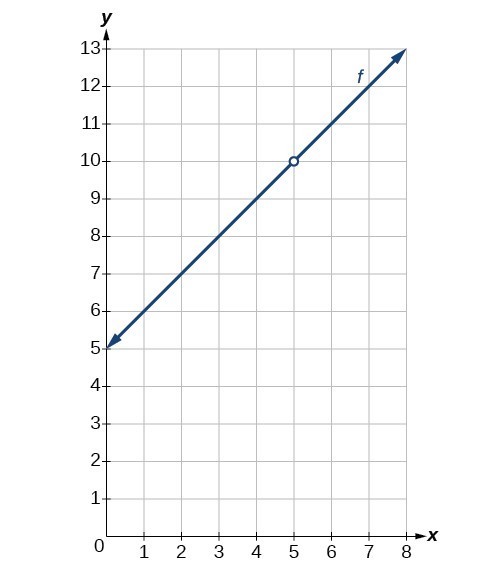
Effigy 12
Try It 3
Make up one's mind whether the part [latex]f\left(ten\right)=\frac{9-{x}^{2}}{{ten}^{ii}-3x}[/latex] is continuous at [latex]x=iii[/latex]. If not, country the type of discontinuity.
Solution
Determining the Input Values for Which a Function Is Discontinuous
Now that we can identify continuous functions, leap discontinuities, and removable discontinuities, we volition wait at more complex functions to find discontinuities. Here, we will analyze a piecewise function to make up one's mind if whatever real numbers exist where the function is non continuous. A piecewise function may have discontinuities at the boundary points of the function every bit well as within the functions that make it upwards.
To determine the real numbers for which a piecewise role composed of polynomial functions is not continuous, recall that polynomial functions themselves are continuous on the gear up of existent numbers. Any discontinuity would be at the boundary points. And then we demand to explore the three conditions of continuity at the boundary points of the piecewise office.
How To: Given a piecewise function, determine whether it is continuous at the boundary points.
- For each boundary indicate [latex]a[/latex] of the piecewise function, determine the left- and right-hand limits as [latex]x[/latex] approaches [latex]a[/latex], every bit well equally the part value at [latex]a[/latex].
- Cheque each status for each value to determine if all three conditions are satisfied.
- Determine whether each value satisfies condition ane: [latex]f\left(a\right)[/latex] exists.
- Make up one's mind whether each value satisfies condition 2: [latex]\underset{x\to a}{\mathrm{lim}}f\left(ten\right)[/latex] exists.
- Determine whether each value satisfies condition 3: [latex]\underset{10\to a}{\mathrm{lim}}f\left(x\correct)=f\left(a\right)[/latex].
- If all three conditions are satisfied, the function is continuous at [latex]x=a[/latex]. If any one of the weather condition fails, the function is not continuous at [latex]10=a[/latex].
Example 4: Determining the Input Values for Which a Piecewise Function Is Discontinuous
Determine whether the part [latex]f[/latex] is discontinuous for any real numbers.
[latex]fx=\begin{cases}x+i, \hfill& 10<2 \\ iii, \hfill& 2\leq ten<4 \\ 10^{2}-11, \hfill& ten\geq 4\end{cases}[/latex]
Solution
The piecewise function is defined by 3 functions, which are all polynomial functions, [latex]f\left(x\correct)=x+1[/latex] on [latex]x<ii[/latex], [latex]f\left(x\right)=3[/latex] on [latex]2\le ten<4[/latex], and [latex]f\left(10\right)={x}^{ii}-5[/latex] on [latex]x\ge iv[/latex]. Polynomial functions are continuous everywhere. Any discontinuities would be at the boundary points, [latex]ten=2[/latex] and [latex]x=4[/latex].
At [latex]x=2[/latex], let us check the three weather condition of continuity.
Status ane:
[latex]\begin{array}{l}f\left(ii\right)=3\\ \Rightarrow \text{Condition 1 is satisfied}.\terminate{assortment}[/latex]
Status ii: Considering a different function defines the output left and right of [latex]ten=ii[/latex], does [latex]\underset{x\to {2}^{-}}{\mathrm{lim}}f\left(x\right)=\underset{x\to {ii}^{+}}{\mathrm{lim}}f\left(x\right)?[/latex]
- Left-mitt limit: [latex]\underset{10\to {2}^{-}}{\mathrm{lim}}f\left(x\right)=\underset{x\to {2}^{-}}{\mathrm{lim}}\left(x+1\correct)=2+i=3[/latex]
- Right-hand limit: [latex]\underset{10\to {2}^{+}}{\mathrm{lim}}f\left(x\correct)=\underset{x\to {ii}^{+}}{\mathrm{lim}}3=three[/latex]
Because [latex]3=3[/latex] , [latex]\underset{10\to {2}^{-}}{\mathrm{lim}}f\left(ten\correct)=\underset{ten\to {2}^{+}}{\mathrm{lim}}f\left(ten\correct)[/latex]
[latex]\Rightarrow \text{Condition 2 is satisfied}[/latex].
Status 3:
[latex]\begin{array}{l}\underset{ten\to 2}{\mathrm{lim}}f\left(x\right)=3=f\left(2\correct)\\ \Rightarrow \text{Condition 3 is satisfied}.\end{array}[/latex]
Because all three conditions are satisfied at [latex]ten=2[/latex], the function [latex]f\left(x\right)[/latex] is continuous at [latex]x=2[/latex].
At [latex]x=4[/latex], let us check the iii conditions of continuity.
Condition 2: Because a unlike function defines the output left and right of [latex]x=four[/latex], does [latex]\underset{x\to {iv}^{-}}{\mathrm{lim}}f\left(x\correct)=\underset{x\to {iv}^{+}}{\mathrm{lim}}f\left(x\right)?[/latex]
- Left-hand limit: [latex]\underset{x\to {4}^{-}}{\mathrm{lim}}f\left(x\right)=\underset{x\to {four}^{-}}{\mathrm{lim}}3=3[/latex]
- Right-mitt limit: [latex]\underset{10\to {4}^{+}}{\mathrm{lim}}f\left(x\right)=\underset{10\to {iv}^{+}}{\mathrm{lim}}\left({x}^{2}-xi\correct)={4}^{2}-11=5[/latex]
Because [latex]3\ne five[/latex] , [latex]\underset{x\to {iv}^{-}}{\mathrm{lim}}f\left(x\right)\ne \underset{x\to {4}^{+}}{\mathrm{lim}}f\left(10\right)[/latex], then [latex]\underset{10\to four}{\mathrm{lim}}f\left(x\right)[/latex] does not exist.
[latex]\Rightarrow \text{Condition two fails}[/latex].
Because one of the three conditions does not hold at [latex]10=four[/latex], the function [latex]f\left(x\right)[/latex] is discontinuous at [latex]x=4[/latex].
Analysis of the Solution
At [latex]ten=four[/latex], there exists a jump discontinuity. Notice that the function is continuous at [latex]x=2[/latex].
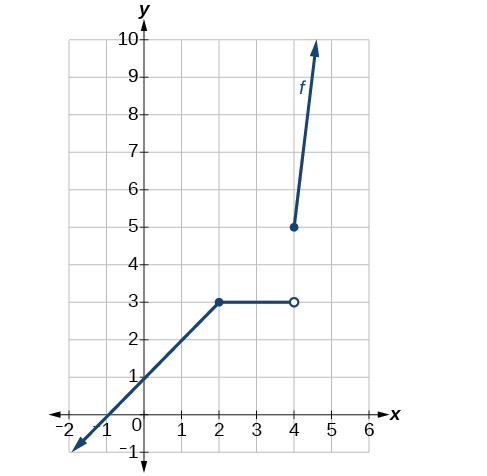
Figure 13. Graph is continuous at [latex]x=2[/latex] but shows a jump discontinuity at [latex]x=4[/latex].
Try Information technology iv
Make up one's mind where the function
[latex]f\left(10\right)=\brainstorm{cases}\frac{\pi x}{4}, \hfill& ten<2 \\ \frac{\pi}{ten}, \hfill& 2\leq 10 \leq 6 \text{ is discontinuous.} \\ 2\pi x, \hfill& x>six\end{cases}[/latex]
Solution
Determining Whether a Part Is Continuous
To make up one's mind whether a piecewise part is continuous or discontinuous, in add-on to checking the boundary points, we must also check whether each of the functions that make upwardly the piecewise function is continuous.
How To: Given a piecewise function, determine whether information technology is continuous.
- Determine whether each component function of the piecewise function is continuous. If there are discontinuities, exercise they occur within the domain where that component office is applied?
- For each boundary indicate [latex]x=a[/latex] of the piecewise part, make up one's mind if each of the three conditions concord.
Instance v: Determining Whether a Piecewise Function Is Continuous
Decide whether the role below is continuous. If it is not, state the location and blazon of each discontinuity.
[latex]fx=\begin{cases}sin\left(x\right), \hfill& x<0 \\ x^{3}, \hfill& x>0\end{cases}[/latex]
Solution
The two functions composing this piecewise function are [latex]f\left(x\right)=\sin \left(10\right)[/latex] on [latex]x<0[/latex] and [latex]f\left(x\right)={10}^{3}[/latex] on [latex]ten>0[/latex]. The sine function and all polynomial functions are continuous everywhere. Whatsoever discontinuities would be at the boundary point,
At [latex]ten=0[/latex], let us check the three weather of continuity.
Condition one:
[latex]\brainstorm{array}{l}f\left(0\right)\text{ does not exist}.\hfill \\ \Rightarrow \text{Condition i fails}.\hfill \end{array}[/latex]
Considering all 3 atmospheric condition are not satisfied at [latex]ten=0[/latex], the function [latex]f\left(x\correct)[/latex] is discontinuous at [latex]10=0[/latex].
Analysis of the Solution
There exists a removable discontinuity at [latex]ten=0[/latex]; [latex]\underset{10\to 0}{\mathrm{lim}}f\left(x\right)=0[/latex], thus the limit exists and is finite, but [latex]f\left(a\correct)[/latex] does non exist.
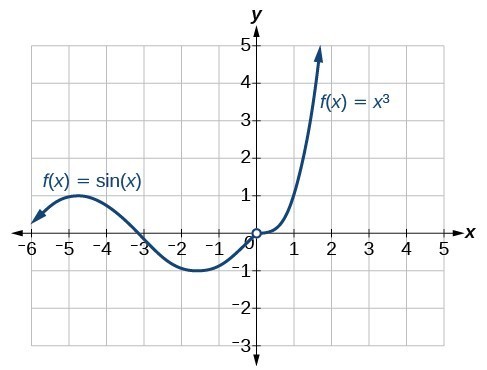
Figure fourteen. Office has removable discontinuity at 0.
Primal Concepts
- A continuous role tin be represented by a graph without holes or breaks.
- A role whose graph has holes is a discontinuous function.
- A office is continuous at a item number if three conditions are met:
- Condition i: [latex]f\left(a\right)[/latex] exists.
- Condition 2: [latex]\underset{x\to a}{\mathrm{lim}}f\left(x\correct)[/latex] exists at [latex]x=a[/latex].
- Condition 3: [latex]\underset{10\to a}{\mathrm{lim}}f\left(x\correct)=f\left(a\right)[/latex].
- A office has a spring discontinuity if the left- and right-manus limits are dissimilar, causing the graph to "jump."
- A function has a removable aperture if information technology can be redefined at its discontinuous point to make it continuous.
- Some functions, such every bit polynomial functions, are continuous everywhere. Other functions, such as logarithmic functions, are continuous on their domain.
- For a piecewise part to be continuous each piece must be continuous on its part of the domain and the part every bit a whole must be continuous at the boundaries.
Glossary
- continuous function
- a function that has no holes or breaks in its graph
- discontinuous function
- a part that is not continuous at [latex]x=a[/latex]
- leap discontinuity
- a point of discontinuity in a function [latex]f\left(x\right)[/latex] at [latex]x=a[/latex] where both the left and right-hand limits exist, but [latex]\underset{x\to {a}^{-}}{\mathrm{lim}}f\left(x\right)\ne \underset{10\to {a}^{+}}{\mathrm{lim}}f\left(x\right)[/latex]
- removable discontinuity
- a point of discontinuity in a role [latex]f\left(x\correct)[/latex] where the function is discontinuous, but can be redefined to get in continuous
Section Exercises
1. Country in your ain words what it means for a part [latex]f[/latex] to be continuous at [latex]x=c[/latex].
2. Country in your own words what it means for a function to exist continuous on the interval [latex]\left(a,b\right)[/latex].
For the following exercises, make up one's mind why the function [latex]f[/latex] is discontinuous at a given betoken [latex]a[/latex] on the graph. State which condition fails.
3. [latex]f\left(10\right)=\mathrm{ln}\text{ }|\text{ }10+3\text{ }|,a=-3[/latex]
iv. [latex]f\left(x\right)=\mathrm{ln}\text{ }|\text{ }5x - ii\text{ }|,a=\frac{2}{5}[/latex]
five. [latex]f\left(x\correct)=\frac{{x}^{ii}-xvi}{x+4},a=-4[/latex]
six. [latex]f\left(10\right)=\frac{{ten}^{2}-16x}{x},a=0[/latex]
7. [latex]f\left(x\right)=\begin{cases}ten,\hfill& 10\neq 3 \\ 2x, \hfill& x=three\end{cases}a=iii[/latex]
viii. [latex]f\left(ten\correct)=\begin{cases}5, \hfill& x\neq 0 \\ 3, \hfill& x=0\end{cases} a=0[/latex]
nine. [latex]f\left(x\right)=\begin{cases}\frac{1}{ii-x}, \hfill& x\neq 2 \\ three, \hfill& x=2\cease{cases}a=two[/latex]
10. [latex]f\left(10\right)=\begin{cases}\frac{ane}{x+six}, \hfill& 10=-6 \\ ten^{2}, \hfill& x\neq -6\stop{cases}a=-6[/latex]
11. [latex]f\left(x\right)=\begin{cases}3+x, \hfill& x<1 \\ 10, \hfill& x=1 \\ x^{2}, \hfill& x>1\cease{cases}a=ane[/latex]
12. [latex]f\left(x\right)=\begin{cases}three-x, \hfill& x<1 \\ x, \hfill& x=1 \\ 2x^{two}, \hfill& x>1\end{cases} a=1[/latex]
thirteen. [latex]f\left(x\right)=\begin{cases}3+2x, \hfill& 10<1 \\ x, \hfill& x=1 \\ -x^{2}, \hfill& x>one\finish{cases}a=i[/latex]
14. [latex]f\left(x\right)=\begin{cases}x^{2}, \hfill& x<-two \\ 2x+one, \hfill& x=-two \\ 10^{3}, \hfill& ten>-2\cease{cases}a=-2[/latex]
fifteen. [latex]f\left(x\correct)=\begin{cases}\frac{x^{2}-nine}{x+3}, \hfill& x<-3 \\ ten-nine, \hfill& x=-iii \\ \frac{1}{x}, \hfill& x>-3\cease{cases}a=-3[/latex]
xvi. [latex]f\left(10\right)=\begin{cases}\frac{x^{2}-9}{10+3}, \hfill& x<-3 \\ x-9, \hfill& ten=-iii \\ -6, \hfill& x>-3\end{cases}a=three[/latex]
17. [latex]f\left(x\correct)=\frac{{x}^{2}-4}{x - two},\text{ }a=2[/latex]
18. [latex]f\left(10\right)=\frac{25-{ten}^{2}}{{x}^{ii}-10x+25},\text{ }a=v[/latex]
19. [latex]f\left(10\right)=\frac{{x}^{3}-9x}{{x}^{2}+11x+24},\text{ }a=-3[/latex]
20. [latex]f\left(ten\right)=\frac{{x}^{three}-27}{{x}^{two}-3x},\text{ }a=iii[/latex]
21. [latex]f\left(x\correct)=\frac{x}{|ten|},\text{ }a=0[/latex]
22. [latex]f\left(ten\correct)=\frac{2|x+ii|}{x+ii},\text{ }a=-ii[/latex]
For the following exercises, decide whether or non the given office [latex]f[/latex] is continuous everywhere. If it is continuous everywhere it is divers, state for what range it is continuous. If information technology is discontinuous, state where it is discontinuous.
23. [latex]f\left(x\correct)={x}^{three}-2x - 15[/latex]
24. [latex]f\left(x\correct)=\frac{{10}^{2}-2x - 15}{x - 5}[/latex]
25. [latex]f\left(ten\right)=2\cdot {3}^{x+4}[/latex]
26. [latex]f\left(10\right)=\mathrm{-sin}\left(3x\right)[/latex]
27. [latex]f\left(x\right)=\frac{|10 - 2|}{{ten}^{ii}-2x}[/latex]
28. [latex]f\left(10\right)=\tan \left(x\right)+2[/latex]
29. [latex]f\left(ten\right)=2x+\frac{5}{x}[/latex]
30. [latex]f\left(x\correct)={\mathrm{log}}_{2}\left(10\right)[/latex]
31. [latex]f\left(ten\correct)=\mathrm{ln}\text{ }{ten}^{2}[/latex]
32. [latex]f\left(x\right)={e}^{2x}[/latex]
33. [latex]f\left(x\correct)=\sqrt{x - iv}[/latex]
34. [latex]f\left(ten\right)=\sec \left(ten\correct)-3[/latex] .
35. [latex]f\left(x\right)={10}^{2}+\sin \left(x\right)[/latex]
36. Decide the values of [latex]b[/latex] and [latex]c[/latex] such that the following function is continuous on the entire real number line.
[latex]f\left(x\right)=\begin{cases}x+ane, \hfill& {1 }<{x }<{3 }\\ x^{2}+bx+c, \hfill& |ten-2|\geq 1\end{cases}[/latex]
For the post-obit exercises, refer to Figure xv. Each foursquare represents one square unit. For each value of [latex]a[/latex], determine which of the three conditions of continuity are satisfied at [latex]x=a[/latex] and which are not.
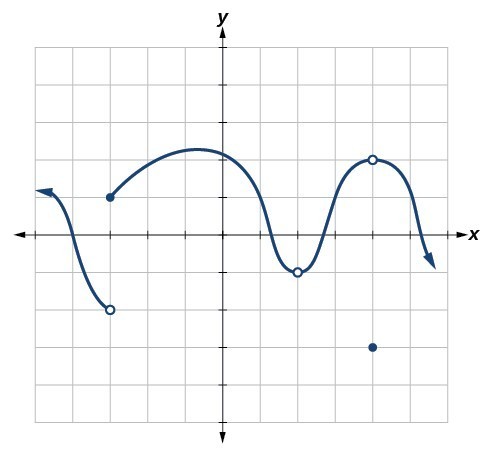
Effigy 15
37. [latex]x=-three[/latex]
38. [latex]x=2[/latex]
39. [latex]x=4[/latex]
For the post-obit exercises, use a graphing utility to graph the function [latex]f\left(x\right)=\sin \left(\frac{12\pi }{x}\right)[/latex] every bit in Effigy sixteen. Set the x-axis a short altitude before and afterward 0 to illustrate the point of discontinuity.
![Graph of the sinusodial function with a viewing window of [-10, 10] by [-1, 1].](https://s3-us-west-2.amazonaws.com/courses-images-archive-read-only/wp-content/uploads/sites/923/2015/04/24234749/CNX_Precalc_Figure_12_03_202F.jpg)
Effigy sixteen
40. Which weather for continuity fail at the point of discontinuity?
41. Evaluate [latex]f\left(0\right)[/latex].
42. Solve for [latex]x[/latex] if [latex]f\left(x\right)=0[/latex].
43. What is the domain of [latex]f\left(10\correct)?[/latex]
For the following exercises, consider the function shown in Figure 17.
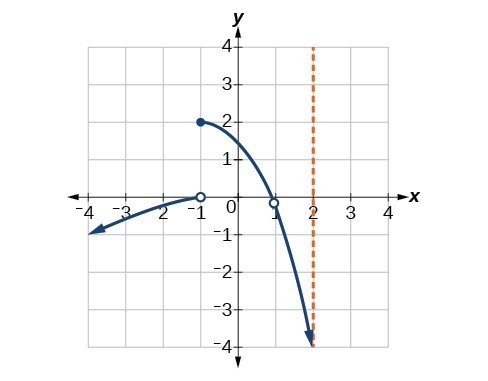
Figure 17
44. At what x-coordinates is the office discontinuous?
45. What status of continuity is violated at these points?
46. Consider the function shown in Effigy eighteen. At what x-coordinates is the function discontinuous? What condition(s) of continuity were violated?
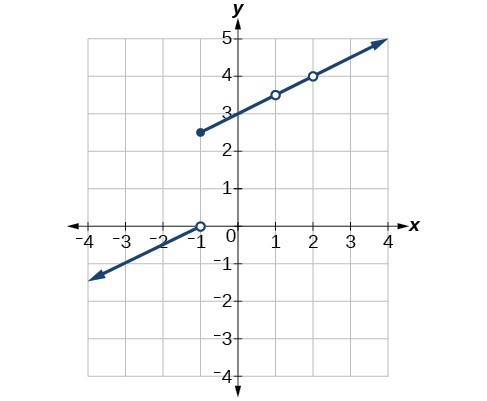
Figure 18
47. Construct a function that passes through the origin with a constant gradient of 1, with removable discontinuities at [latex]ten=-7[/latex] and [latex]x=1[/latex].
48. The function [latex]f\left(x\right)=\frac{{x}^{3}-i}{x - one}[/latex] is graphed in Figure 19. Information technology appears to be continuous on the interval [latex]\left[-3,three\right][/latex], merely at that place is an ten-value on that interval at which the office is discontinuous. Determine the value of [latex]x[/latex] at which the part is discontinuous, and explain the pitfall of utilizing technology when considering continuity of a function past examining its graph.
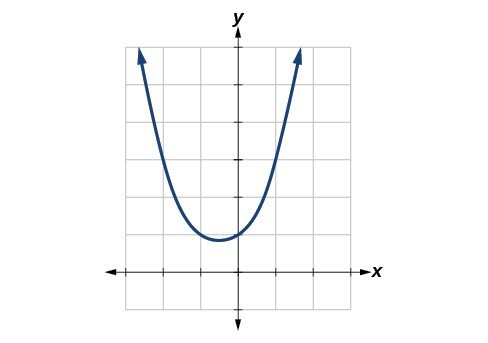
Figure xix
49. Notice the limit [latex]\underset{10\to 1}{\mathrm{lim}}f\left(ten\correct)[/latex] and determine if the following function is continuous at [latex]x=1:[/latex]
50. The function is discontinuous at [latex]ten=1[/latex] considering the limit every bit [latex]ten[/latex] approaches 1 is 5 and [latex]f\left(1\correct)=2[/latex].
51. The graph of [latex]f\left(x\right)=\frac{\sin \left(2x\correct)}{x}[/latex] is shown in Figure xx. Is the part [latex]f\left(x\right)[/latex] continuous at [latex]10=0?[/latex] Why or why not?
![Graph of the function f(x) = sin(2x)/x with a viewing window of [-4.5, 4.5] by [-1, 2.5]](https://s3-us-west-2.amazonaws.com/courses-images-archive-read-only/wp-content/uploads/sites/923/2015/04/24234755/CNX_Precalc_Figure_12_03_206.jpg)
Figure 20
gonzalesyoughoor1972.blogspot.com
Source: https://courses.lumenlearning.com/precalctwo/chapter/continuity/
0 Response to "How to Do You Know if a Piecewise Function Is Continuous or Not"
Post a Comment