Was Minimum Wage Meant to Support a Family
Chairman Harkin, Ranking Member Alexander, and Members of the Assist Committee, cheers for inviting me to prove this afternoon. My name is James Sherk. I am a Senior Policy Analyst in Labor Economics at The Heritage Foundation. The views I express in this testimony are my own, and should non be construed equally representing whatever official position of The Heritage Foundation.
Supporters of the minimum wage intend information technology to lift depression-income families out of poverty. Unfortunately, despite these skilful intentions, the minimum wage has proved ineffective at doing so. Indeed, information technology often holds back many of the workers its proponents want to help. Higher minimum wages both reduce overall employment and encourage relatively flush workers to enter the labor force. Minimum wage increases often lead to employers replacing disadvantaged adults who need a job with suburban teenagers who practice not.
This can have long-term consequences. Minimum wage positions are typically learning wage positions—they enable workers to gain the skills necessary to become more productive on the job. As workers get more productive they command higher pay and motion up their career ladder. Ii-thirds of minimum wage workers earn a raise within a twelvemonth. Raising the minimum wage makes such entry-level positions less available, in outcome sawing off the bottom rung of many workers' career ladders. This hurts these workers' career prospects.
Even if minimum wage workers do not lose their chore, the overlapping and uncoordinated design of U.S. welfare programs prevents those in need from benefitting from higher wages. As their income rises they lose federal tax credits and help. These do good losses offset most of the wage increase. A single mother with ane kid faces an effective marginal taxation rate of 91 percent when her pay rises from $seven.25 to $10.10 an hr. Studies also discover college minimum wages do non reduce poverty rates. Despite the all-time of intentions, the minimum wage has proved an ineffective—and often counterproductive—policy in the state of war on poverty.
Congress could exercise more to assist low-income families by restructuring and analogous welfare programs and their associated stage-out rates. No one in American—and particularly not low-income workers—should confront tax rates in excess of 50 per centum.
History of the Minimum Wage
Congress instituted the minimum wage in 1938 as part of the Off-white Labor Standards Act (FLSA). The commencement minimum wage stood at 25 cents an hour. The terminal minimum wage increment occurred in 2007, when Congress raised the rate in steps from $5.xv an hour that year to $seven.25 an hour in July 2009. The Commune of Columbia and 19 states have also established local minimum wages higher than the federal rate. The highest state minimum wage in the land occurs in Washington State at $nine.19 an hour. The average minimum wage in the U.Due south.—including higher land rates—currently stands at $7.57 an 60 minutes.[ane]
Over the past 65 years the minimum wage has varied considerably in inflation-adjusted buying power. It has averaged $vi.60 an hour in purchasing ability in 2013 dollars. But information technology has ranged from a low of $3.09 an 60 minutes in belatedly 1948 to a high of $eight.67 an hour in 1968.[2] Today's minimum wage buys somewhat more than the minimum wage has historically, although it remains over a dollar an hr below its historical high.[3]

Congress typically raises the minimum wage just during times of good for you economic growth and low unemployment. In 1990, Congress enacted a minimum wage hike that took effect on April i of that year, when unemployment stood at 5.4 percent. Congress voted to raise the minimum wage again in Baronial 1996—when unemployment stood at v.i percentage. The next vote to raise the minimum wage occurred in May 2007, when unemployment stood at 4.four percent.[4] Congress has not voted to raise the minimum wage when unemployment stood to a higher place 7.5 percent since the Great Depression concluded.[5]
Who Earns the Minimum Wage?
Stereotypes of minimum wage earners range from teenagers property summertime jobs to unmarried mothers struggling to back up their family. Agency of Labor Statistics (BLS) data sheds light on who actually makes the minimum wage.
Relatively few Americans do so. In 2011 and 2012, 3.7 million Americans reported earning $7.25 or less per hour—merely two.9 percent of all workers in the United States.[half-dozen][seven][8] Those who do work in minimum-wage jobs fall into two distinct categories: immature workers, usually in school, and older workers who accept left school. Most minimum-wage earners fall into the kickoff category; just over half are between the ages of 16 and 24.[9] The residuum are 25 or older. Table 1 shows the characteristics of minimum wage workers overall, and cleaved downwards past age groups.
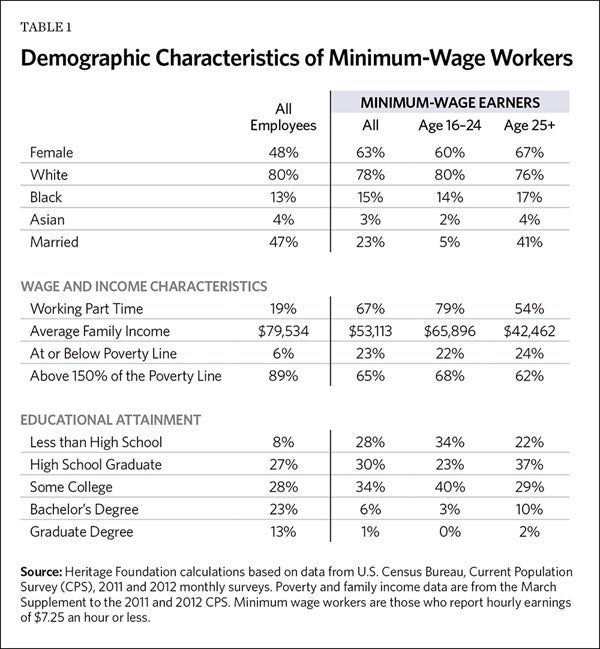
Minimum-wage workers under 25 are typically not their family's sole breadwinners. Rather, they tend to alive in middle-course households that do not rely on their earnings—their average family income exceeds $65,000 a year. Generally, they have non finished their schooling and are working function-fourth dimension jobs. Over three-fifths of them (62 percent) are currently enrolled in school.[ten] Merely 22 percent live at or below the poverty line, while two-thirds alive in families with incomes exceeding 150 percent of the poverty line. These workers correspond the largest group that would benefit directly from a college minimum wage, provided they kept or could discover a task.
Adults who earn the minimum wage are less likely to live in middle- and upper-income families. Nevertheless, three-fourths of older workers earning the minimum wage live to a higher place the poverty line. They accept an average family income of $42,500 a year, well higher up the poverty line of $23,050 per year for a family of four. Virtually (54 percent) of them choose to piece of work part time, and 2-fifths are married.
Many advocates of raising the minimum wage argue it will help low-income single parents surviving on it equally their only source of income. Minimum-wage workers, however, do non fit this stereotype. Just iv percent of minimum-wage workers are single parents working full time, compared to 5.6 percent of all U.S. workers.[xi] Minimum-wage earners are actually less likely to be unmarried parents working full time than the average American worker.
Though some minimum-wage workers do struggle with poverty, they are not representative of the typical worker in minimum-wage jobs. The data simply does not support the stereotype of minimum-wage workers living on the border of destitution.
Learning Wage Positions
Most minimum wage jobs are entry-level positions filled by workers with limited education and feel. As Table 1 shows, virtually three-fifths of minimum wage workers have no more than than a high school teaching. They work for the minimum wage considering they currently lack the productivity to command college pay.
Minimum-wage jobs requite these workers feel and teach them essential task skills. Sometimes these skills are unique to an individual task, such as how to operate a particular piece of equipment. More often they pertain to general employability: the bailiwick of waking up early to become to work each mean solar day, learning how to collaborate with customers and coworkers, how to accept direction from a dominate. These skills are essential to getting ahead in the workplace, but difficult to learn without actual on-the-job experience.
Once workers gain these skills they become more productive, and about quickly earn raises. Over 2-thirds of workers starting out at the minimum wage earn more than that a year later.[12] Minimum-wage jobs are learning wage jobs—they teach inexperienced employees skills that brand them more than productive. They are the first step on many workers' career ladders.
While very few Americans currently work for the minimum wage, a substantial number once did so. Over half of American started their careers making within one dollar of the minimum wage.[xiii] Nearly quickly get promoted as their productivity increases.
Workers have a say in how quickly they get promoted. Most minimum-wage earners piece of work part time, and many are students and young adults who desire this flexibility. But minimum-wage workers who choose to work longer hours gain more than skills and experience than those who work part time and, equally expected, earn larger raises. A typical minimum-wage employee who works 35 hours or more a week is thirteen percentage points more likely to exist promoted within a year than is a minimum-wage worker putting in fewer than 10 hours per week.[fourteen]
The notion that workers are trapped earning $vii.25 an hour for much of their working lives is mistaken and ignores the primary value of minimum-wage jobs. Their importance lies non then much in the low wages they pay in the nowadays, but in making workers more productive so they tin command higher pay in the hereafter.
Labor Need Falls as Prices Increase
Ane of the central premises of economics is that "demand curves slope downwardly"—when prices rise people purchase less of a proficient or service. When gasoline becomes more than expensive Americans bulldoze less, and when it becomes less costly Americans bulldoze more than. The same applies to business owners. When the price of goods or services they use in production rises, they purchase less of them. This includes labor costs—when wages rising employers hire fewer workers. Economists estimate the long-run elasticity of labor need in the U.S. economic system at around –0.3.[15] In other words, a ten per centum increase in labor costs causes employers to cut their workforce by three percentage. Higher compensation costs without corresponding increases in productivity cause employers to hire fewer workers.
This finding applies to employers of both highly skilled and unskilled workers.[xvi] Employers will not pay a worker more than than their productive value to a house. Businesses that practise and so apace go out of businesses.
American Samoa
The recent experience of American Samoa dramatically illustrates how wage increases reduce employment. The tiny Pacific island chain has been an American territory for over a century. However, American Samoans have a largely carve up economic system and considerably lower incomes than residents of the continental United States: the average Samoan worker made $12,000 in 2009.[17] The tuna canning industry makes up a significant portion of their individual sector.
Until recently American Samoa had a unlike minimum wage schedule than the continental Us. A committee within the Department of Labor set Samoan wage minimums according to local economical atmospheric condition. In January 2007 the minimum wage in the canning industry stood at $3.26 an 60 minutes. Unfortunately for American Samoa, Congress applied the 2007 federal minimum wage increase to the territory. The legislation aligned the Samoan minimum wage with the U.S. rate of $vii.25 an 60 minutes in l cent annual increments.[18]
Near every hourly worker in the tuna canning manufacture makes less than $seven.25 an 60 minutes.[19] At that level the minimum wage would cover 80 percent of the islands' hourly workers.[twenty] This would exist the economic equivalent of raising the minimum wage to $xx.00 an hour in the continental U.Southward.[21]
By May 2009 the 3rd scheduled minimum wage increment in Samoa took effect, ascent to $four.76 an hour and covering 69 pct of canning workers. This did not increase purchasing ability, stimulate need, and heighten living standards, every bit many minimum wage proponents theorize. Instead StarKist—one of the two canneries so located in Samoa—laid off workers, cut hours and benefits, and froze hiring.[22] The other cannery—Chicken of the Sea—shut down entirely in September 2009.[23]
The Government Accountability Office reports that between 2006 and 2009 overall employment in American Samoa vicious 14 percent and inflation-adapted wages barbarous 11 percent. Employment in the tuna canning industry fell 55 percent.[24] The GAO attributed much of these economic losses to the minimum wage hike.
The Democratic Governor of American Samoa, Togiola Tulafona, harshly criticized this GAO report for understating the damage done by the minimum wage hike. Testifying before Congress Gov. Tulafona objected that "this GAO report does not adequately, succinctly or clearly convey the magnitude of the worsening economical disaster in American Samoa that has resulted primarily from the imposition of the 2007 Usa minimum wage mandate."[25] Gov. Tulafona pointed out that American Samoa'southward unemployment charge per unit jumped from 5 percent before the terminal minimum wage hike to over 35 per centum in 2009.[26] He begged Congress to end increasing the islands' minimum wage:
"Nosotros are watching our economy burn down. We know what to exercise to stop it. We demand to bring the aggressive wage costs decreed by the Federal Authorities under control. But nosotros are ordered not to interfere …Our chore market is being torched. Our businesses are existence depressed. Our promise for growth has been driven abroad…Our question is this: How much does our government expect us to suffer, until nosotros accept to stand upwards for our survival?"[27]
Samoan employers responded to higher labor costs the way economical theory predicts: by hiring fewer workers. Congress hurt the very workers it intended to help. Fortunately, Congress heeded the Governor'southward plea and suspended the future scheduled minimum wage increases.
Minimum Wage Employment Furnishings
About no economist doubts that raising the minimum wage to $xx.00 an hr in the mainland U.S. would have similar consequences. Economists only contend the consequences of minor minimum wage increases.
In function this is because, at current rates, the minimum wage affects very few workers, and so it has relatively small effects on the overall economy. Fifty-fifty groups considered highly affected by the minimum wage have few minimum-wage workers overall. But one-5th of teenagers and restaurant employees work for the federal minimum wage.[28] Raising the minimum wage by $i.00 an 60 minutes – every bit many states have washed – has footling effect on most workers, fifty-fifty most teenagers. Consequently, a moderate increase in the minimum wage will have only small-scale furnishings on the U.S. economy. It affects too few workers to have a larger impact. A police force eliminating a 10th of minimum-wage jobs would raise overall unemployment by less than 0.iii percentage point.[29] Congress should not conflate small effects with no effect. The minimum wage does hurt the prospects of the relatively pocket-size number of workers it covers.
Until the mid-1990s, labor economists had a consensus that a 10 percent increase in the minimum wage reduced employment of impacted groups (like teenagers) by about two percent.[30] Research past David Menu of the University of California-Berkeley challenged this conclusion.[31] His inquiry, focusing on example studies of states that raised the minimum wage and states that did not, concluded the minimum wage had no adverse consequence on employment. This spurred an explosion of enquiry on the topic. This inquiry coincided with a pregnant number of states raising their minimum wages above the federal level in the 1990s and 2000s. These state increases created far more instance studies for economists to analyze and permitted panel studies utilizing variation in minimum wage rates across all U.S. states.
Two-thirds of the studies in this "new minimum wage research" utilizing land variation in minimum wages came to the same determination that previous economists had: higher minimum wages reduce the employment of less-skilled workers.[32] Amidst the virtually methodologically rigorous studies, 85 percent came to this conclusion.
A recent line of papers by Michael Reich, Arindrajit Dube, and Sylvia Allegretto competition these findings.[33] They argue that states that raised their minimum wage to a higher place the federal level (typically in the Northeast and West Coast) have slower underlying employment growth than states that did not raise their minimum wage (typically in the Due south and Mountain West). They contend that studies finding negative employment furnishings conflate these pre-existing trends with the effects of higher minimum wages. They find that in one case researchers control for state or regional trends the negative relationship goes away. They and then compared counties that edge each other across a state line and concluded college minimum wages accept negligible employment effects on teenagers and eating place employees.
David Neumark of the Academy of California–Irvine and William Wascher of the Federal Reserve Board strongly dispute this critique.[34] They show that the testify for pre-existing trends biasing previous studies is weak. They demonstrate that information technology takes very specific controls to make the human relationship between the minimum wage and job losses disappear. Using more general specifications favored past economists produces the standard conclusion that minimum wage increases price jobs.
Neumark and Wascher also argue that the many counties compared beyond country borders have very unlike economical climates. For example, Dube et al. compare urban Leon County in Florida (the home canton of Tallahassee) with its population of 275,000 to rural Grady County, Georgia – population 25,000. Neumark and Wascher used statistical tests to clarify how closely the labor markets of these cross-border counties resemble each other. They find that among reasonable candidates for comparison, the cross-border counties "appear no better than a random describe."[35]
They conclude that economists should wait at data from all states, not but cross-border comparisons, and use standard specifications to command for pre-existing trends. Doing so produces the usual finding that minimum wage increases toll jobs. Raising the price of unskilled labor causes employers to rent fewer unskilled workers.
Crowding Out Disadvantaged Workers
The minimum wage specially hurts disadvantaged workers' task prospects. Higher minimum wages encourage employers to replace less-skilled workers with more productive employees. Given the selection between hiring an unskilled worker for $10.10 an 60 minutes and a worker with more experience for the aforementioned charge per unit, companies will ever cull the more than experienced and productive employee.
Higher minimum wages also make working in such jobs more attractive, cartoon greater numbers of workers with exterior sources of income into the labor market place. Many suburban teenagers and higher students enter the labor market when the minimum wage rises. As they utilize for job openings they crowd out urban teenagers and disadvantaged adults who would have sought the jobs at the previous wages. Overall, the minimum wage reduces disadvantaged workers' employment much more than it reduces overall employment. It causes the very workers minimum wage advocates near want to aid to have the greatest difficulty finding jobs.
Empirical research consistently bears this out. I recent study examined authoritative information from a large retail chain.[36] When the minimum wage rose, the concatenation slightly reduced overall employment. Surprisingly, nevertheless, teenage employment rose in several stores. These teen employment gains came at the expense of larger job losses among adults. The composition of teenage employment also changed, with more teens coming from wealthier neighborhoods and fewer from low-income neighborhoods. The college wages prompted many suburban teenagers to apply for work. They crowded many low-income adults and youth out of jobs.
Some other study examined how teenage employment and school enrollment changed after states raised their minimum wage.[37] It constitute that when states raised their minimum wage, younger teens and those who had dropped out of schoolhouse were more likely to become unemployed. At the same time, higher-skill teenagers were more likely become jobs. When they have to pay higher wages, businesses hire higher-skill workers, freezing the to the lowest degree productive workers out of the chore market.
Even studies that find the minimum wage has negligible overall employment effects detect it decreases the employment of disadvantaged workers. Kevin Lang and Shulamit Kahn of Boston University examined how restaurant employment changed later minimum wage hikes in the tardily 1980s and early 1990s.[38] They found no evidence that the minimum wage reduced full eating place employment, but they did find that it dramatically inverse the mix of workers that restaurants hired. Teenage and student employment rose, while developed employment dropped.
A college minimum wage is great news for a high school student working office fourth dimension to buy an iPhone. It hurts lower-skill adult workers who need work to support themselves and perhaps their families. Making entry-level jobs less available makes information technology harder for them to gain the skills and feel necessary to accelerate to better paying jobs. The minimum wage effectively saws off the first rung on their career ladder.
Footling Benefit to Families in Poverty
The minimum wage raises the pay of many workers at the toll of some jobs. A lot of advocates for minimum wage increases consider this a good trade-off. They argue that the gains for the workers who benefit far outweigh the costs to those who lose out. For case, raising the minimum wage by forty pct – from $7.25 an 60 minutes to $10.10 an hour – would cost roughly 8 percent of heavily affected worker groups their jobs (although losses would exist larger among the most disadvantaged workers).[39] At start glance this may seem like a good deal.
Notwithstanding, this assay ignores the way American tax and welfare programs claw back wage gains made by low-income workers. Congress has created many overlapping means-tested benefit programs: the supplemental diet assistance program (SNAP, formerly called food stamps), temporary aid for needy families (TANF), the Earned Income Tax Credit (EITC), kid-care subsidies, housing vouchers, and Women, Infants, and Children (WIC) benefits. The government also provides all-encompassing in-kind health care benefits: Medicaid, SCHIP, and the soon to exist operating health intendance commutation subsidies.
These benefits phase out at different rates as income rises. Earning an additional dollar of income reduces SNAP benefits by 24 cents. Workers in the EITC stage-out range lose 21 cents for each additional dollar they earn. Housing vouchers phase out at a 30 percentage charge per unit. Low-income workers must also pay payroll (15 percent) and income taxes (10-15 percentage) on each boosted dollar of income. Medicaid operates with a cliff: when workers' incomes exceed a sure threshold, they lose all benefits.
Congress did not coordinate these benefit phase-outs across programs. Consequently low-income workers can face up very high effective taxation rates every bit they lose benefits from multiple programs. Consider workers both losing SNAP benefits and landing in the EITC phase out range. For each additional dollar they earn they pay 15 cents in additional payroll taxes, 15 cents in income taxes, an average of v cents in country income taxes, as well as losing 21 cents of their EITC benefit and forgoing 24 cents of SNAP benefits – an effective marginal tax rate of fourscore percent. Each extra dollar earned increases their internet income by but xx cents. Not fifty-fifty millionaires pay such high tax rates.
The Congressional Budget Office studied this issue in a written report released concluding yr.[40] It found that a single parent with one child earning between $xv,000 to $25,000 experiences almost no financial benefit from working boosted hours or getting a raise.[41] What they gain in market income they lose in reduced benefits, leaving them no better off.
The academic literature concludes that low-income families financially do good when the head of the household enters the labor strength and takes a chore that pays near the poverty level. However, additional hours of work – or higher wages – beyond that more often than not produce little boosted net benefit until earnings exceed 150 to 200 pct of the poverty level.[42]
Unfortunately, minimum-wage workers with incomes below the poverty level autumn into this earnings expressionless zone. A childless adult working full time for the minimum wage earns $xv,080 a year, to a higher place the poverty level for one person ($11,490). That adult (or a teenager) qualifies for relatively few federal benefits. But a unmarried parent working the aforementioned job would fall beneath the poverty level for either i ($fifteen,510) or two ($nineteen,530) children. That single parent qualifies for many ways-tested federal benefits. If the federal minimum wage rose to $x.10 an hour ($21,008 a year for a full-time job) benefit reductions would claw back the majority of his or her enhance.
Table 2 shows the constructive marginal tax rates facing full-time workers in various family unit situations whose incomes rise from $seven.25 an 60 minutes to $ten.10 an hour. The figures come from the Urban Institute's Net Income Change Reckoner. Some columns prove the effective tax rates when workers participate in all programs for which they are eligible. Others testify the revenue enhancement rate when workers simply participate in nutrient stamps and pay their taxes. Note that these figures understate the effective marginal taxation rates because they exclude the loss of health care benefits like Medicaid and SCHIP. Even without including health benefits, workers lose at least 50 per centum of their benefits and in some cases much more.
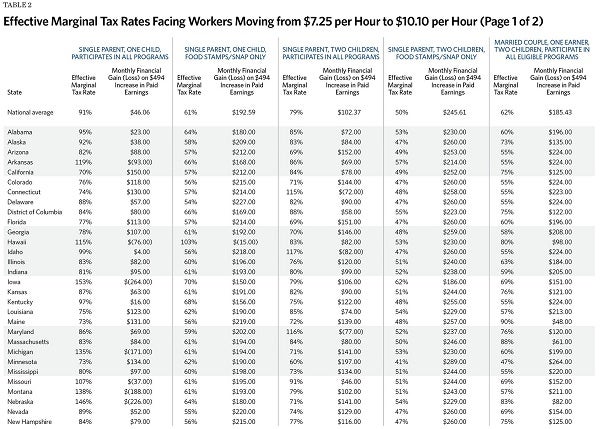
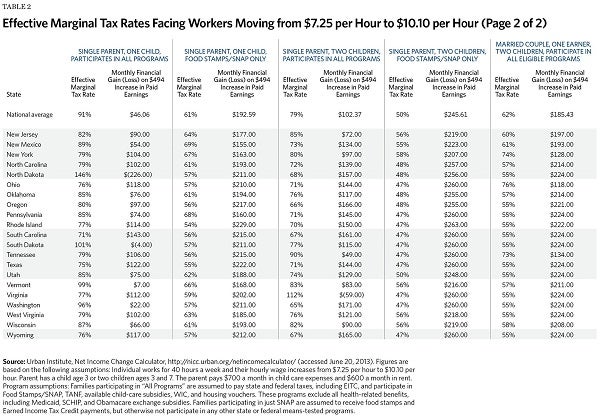
Nationwide, the average single parent with ane child who participates in all programs for which they are eligible faces an effective marginal tax rate of 91 percent. The same parent with ii children faces an effective tax rate of 79 percentage. In some states the raise would actually financially injure families.
Consider a Patty Jones, a hypothetical single mother in Des Moines, Iowa, who gets an offer for a job at minimum wage.[43] If she goes from non working to working full time, her monthly income rises from $one,146 to $1,838. However, if she gets a raise to $ten.10 an hour, her monthly income falls to $1,574. She loses over $260.While her market income rises by $494, she loses $71 in EITC refunds, pays $37 more in payroll taxes and $45 more in country income taxes. She as well loses $88 in food stamp benefits and $528 in child-care subsidies. Patty would be better off without the raise.
This arrangement makes information technology very hard to elevator families out of poverty by raising the minimum wage. College minimum wages brand information technology more hard for disadvantaged adults to find jobs. This hurts their finances. However, for those living below the poverty line who proceed their job, the raise provides little cyberspace benefit. Much or all of what they gain in college pay gets clawed back as reduced benefits.
College students and teenagers with jobs do benefit from a college minimum wage; they have few government benefits to lose. Just Congress does not raise the minimum wage to help teenagers buy jeans or iPhones. Information technology does then to help families struggling below the poverty line. Electric current law makes information technology almost impossible to achieve that goal.
No Effect on Poverty
Economical inquiry further shows that raising the minimum wage does not reduce poverty.[44] Economists accept studied changes in aggregate state poverty rates when states raise their minimum wage. They accept also examined micro-data on private families' finances when the minimum wage changes. A study finds minimum wages reduce poverty.[45] 1 other report finds the opposite issue.[46] Merely the overwhelming balance of recent research finds no effect of the minimum wage on poverty.[47] Even David Carte du jour, a researcher celebrated by minimum wage advocates, comes to this determination.[48]
This should come as piffling surprise. Also reducing job opportunities and the perverse structure of the welfare state, very few poor families have any minimum wage workers. Only eleven percentage of the workers who would gain from raising the minimum wage to $9.50 an hour live at or beneath the poverty line.[49]
In fact, very few poor families accept any full-fourth dimension workers at all. Only 9 percentage of adults living beneath the poverty line work total time twelvemonth round. One quarter work part time. Two-thirds of adults living beneath the poverty line do not piece of work at all.[fifty] Raising the minimum wage hurts their job prospects only does nothing to increment their earnings – they have none.
If Congress wants to reduce poverty it should focus on restructuring the welfare state to remove the electric current disincentives to work. For as well many low-income families boosted work does not pay. Few Americans at any income level would work longer hours when faced with a tax rate exceeding 50 percent.
The Heritage Foundation is a public policy, research, and educational organization recognized every bit exempt under section 501(c)(iii) of the Internal Revenue Lawmaking. It is privately supported and receives no funds from any government at any level, nor does it perform whatever government or other contract work.
The Heritage Foundation is the most broadly supported think tank in the United States. During 2013, it had nearly 600,000 individual, foundation, and corporate supporters representing every state in the U.South. Its 2013 income came from the following sources:
Individuals 80%
Foundations 17%
Corporations 3%
The top five corporate givers provided The Heritage Foundation with 2% of its 2013 income. The Heritage Foundation's books are audited annually by the national accounting business firm of McGladrey, LLP.
Members of The Heritage Foundation staff show every bit individuals discussing their ain contained inquiry. The views expressed are their ain and do not reverberate an institutional position for The Heritage Foundation or its lath of trustees.
Endnotes
[1] Heritage Foundation calculations using data on state minimum wage rates from the Department of Labor, Wage and Hour Partition. The figure is a weighted average, where the weights are each state's respective share of hourly employees in the U.Southward.
[2] Source: Heritage Foundation calculations using data from the Department of Labor, Wage and Hr Division. Inflation adjusted using the Personal Consumption Expenditures (PCE) price alphabetize.
[three] Analysis inflation adjusting historical minimum wage rates with the Consumer Price Alphabetize (CPI) volition study higher real rates. The CPI estimates higher inflation than the PCE alphabetize and other chained measures of aggrandizement do. This results in a larger upwards to historical rates to account for inflation. Using the CPI the minimum wage stood at $x.sixty an hour in 1968. However, economists widely concord that the Laspreyes fixed-basket methodology the CPI utilizes produces less accurate estimates than a chained-index methodology. Consequently this paper uses the PCE index to conform for past inflation. See for case Clinton McCully, Brian Moyer, and Kenneth Stewart, "A Reconciliation betwixt the Consumer Price Index and the Personal Consumption Expenditures Toll Index," Agency of Economic Analysis Papers, September 2007.
[iv] Section of Labor, Bureau of Labor Statistics, "The Employment Situation," Apr 1990, August 1996, May 2007.
[v] Although the economy has slipped into recessions afterwards minimum wage increases (such as in 2007), these contractions were not expected when Congress voted.
[6] Heritage Foundation analysis of data from the Current Population Survey (CPS). The Demography Bureau and Bureau of Labor Statistics jointly conduct the CPS. All numbers, except boilerplate family unit income and poverty status, come from analysis of the 2011 and 2012 Merged Approachable Rotation Group (MORG) file of the CPS. Minimum-wage earners were defined as hourly employees paid $7.25 an hour or less. Poverty and family income statistics come up from the March supplement to the 2011 and 2012 CPS data. Information bachelor for download at http://thedataweb.rm.demography.gov/ftp/cps_ftp.htmlandhttps://cps.ipums.org/cps/
[7] The two.ix percent figure includes both salaried and hourly employees. Approximately five percent of hourly employees get paid the federal minimum wage.
[eight] These numbers include workers who also earn tip income. Many of those earning less than the minimum wage work in restaurants and make more than the minimum wage after taking tips into account.
[9] fifty.5 percent of minimum wage earners are between the ages of 16 and 24.
[10] Heritage Foundation calculations using the 2011 and 2012 Current Population Survey. The months of June, July, and Baronial were excluded to avert conflating summer breaks with non-enrollment.
[11] Heritage Foundation analysis of information from the Electric current Population Survey (CPS). A single parent is defined every bit someone who reports that he or she has i or more than of his or her own children present in the household and who is widowed, divorced, separated, or never married. Full-time employees are classified as those working 35 or more hours a calendar week.
[12] David Macpherson and William Even, "Wage Growth Amidst Minimum Wage Workers," Employment Policies Institute, June 2004, p. 3-5, at world wide web.epionline.org/studies/macpherson_06-2004.pdf.
[13] William Carrington and Bruce Fallick, "Do Some Workers Take Minimum Wage Careers,"Monthly Labor Review, May 2001, pp. 17-27, Table 2
[14] Macpherson and Even, "Wage Growth Among Minimum Wage Workers," pp. viii-11.
[fifteen] Daniel South. Hamermesh,Labor Demand (Princeton, N.J.: Princeton Academy Press, 1993).
[16] Although studies typically find workers with greater skills take a smaller elasticity of demand.
[17] Authorities Accountability Function,American Samoa and the Democracy of the Northern Mariana Islands: Employment, Earnings, and Status of Central Industries Since Minimum Wage Increases Began, Report No. GAO-11-427, June 2011, Figure 11.
[18]Ibid., Table 4.
[nineteen] Government Accountability Office,American Samoa and the Commonwealth of the Northern Mariana Islands,p. 63.
[20] U.S. Department of Labor,Impact of Increased Minimum Wages on the Economies of American Samoa and the Commonwealth of the Northern Mariana Islands, Jan 2008.
[21] Heritage Foundation calculations using information from the Outgoing Rotation Groups of the 2012 monthly electric current population survey. $20.00 an hour is the 80th percentile for workers paid hourly wages.
[22] Government Accountability Office,American Samoa and the Democracy of the Northern Mariana Islands p. 63.
[23]Ibid., p. 40.
[24]Ibid., Table two.
[25] Testimony of American Samoa Governor Togiola Tulafona before the Subcommittee on Fisheries, Wildlife, Oceans and Insular Affairs of the Commission on Natural Resources, U.S. House of Representatives, September 23, 2011. Opening statement available online at http://americansamoa.gov/index.php/news-bottom/30-gov-togiola-tells-u-s-congress-minimum-wage-increase-volition-destroy-as-economy
[26]Ibid., Written Testimony, Table three.
[27]Ibid., opening statement.
[28] Department of Labor, Agency of Labor Statistics, "Characteristics of Minimum Wage Workers – 2012," Tables 1 and 4, athttp://www.bls.gov/cps/minwage2012tbls.htm.
[29] The increment in unemployed would probably be less – many of these workers, especially teenagers and higher students, would probably drib out of the labor market birthday and no longer count equally unemployed.
[30] Charles Brown, Curtis Gilroy, and Andrew Kohen, "The Effect of the Minimum Wage on Employment and Unemployment,"Journal of EconomicLiteratureVol. twenty, No. 2 (June 1982), pp. 487–528.
[31] David Carte and Alan Krueger. "Minimum Wages and Employment: A Case Study of Fast-Food Industry in New Jersey and Pennsylvania,"American Economic Review, Vol. 48, No. 4 (1994), pp. 772-793.
[32] David Neumark and William Wascher,Minimum Wages (Cambridge, MA: The MIT Press, 2008).
[33] See for instance Sylvia Allegretto, Arindrajit Dube, and Michael Reich, "Spatial Heterogeneity and Minimum Wages: Employment Estimates for Teens Using Cross-State Commuting Zones," Berkeley, CA: Institute for Research on Labor and Employment, 2009; Sylvia Allegretto, Arindrajit Dube, and Michael Reich, "Practise Minimum Wages Really Reduce Teen Employment? Accounting for Heterogeneity and Selectivity in State Panel Information,"Industrial Relations, Vol. 50, No. 2, pp. 205-240; Arindrajit Dube, T. William Lester, and Michael Reich, "Minimum Wage Effects Across State Borders: Estimates Using Face-to-face Counties,"Review of Economics and Statistics, Vol. 92, No. 4 (2010), pp. 945-964.
[34] David Neumark, Ian Salas, and William Wascher, "Revisiting the Minimum Wage- Employment Debate: Throwing Out the Babe with the Bathwater?" National Bureau of Economical Research Working Paper No. 18681 (2013), http://www.nber.org/papers/w18681.
[35]Ibid., pp. 27-28.
[36] Laura Giuliano, "Minimum Wage Effects on Employment, Substitution, and the Teenage Labor Supply: Evidence from Personnel Data,"The Journal of Labor Economics, Vol. 31, No. 1 (Jan 2013), pp. 155-194.
[37] David Neumark and William Wascher. "The Effects of Minimum Wages on Teenage Employment and Enrollment: Testify from Matched CPS Surveys," in Solomon Polchek, ed.Research in Labor Economics, Vol. xv (Greenwich, Conn.: JAI Printing, 1996).
[38] Kevin Lang and Shulamit Kahn, "The Effect of Minimum-Wage Laws on the Distribution of Employment: Theory and Prove,"Periodical of Public Economics, Vol. 69, No. 1 (July 1998), pp. 67-82.
[39] This assumes an employment elasticity of –0.2.
[40] Congressional Budget Part, "Effective Marginal Tax Rates for Low – and Moderate- Income Workers," November 2012,http://world wide web.cbo.gov/sites/default/files/cbofiles/attachments/xi-15-2012-MarginalTaxRates.pdf.
[41]Ibid., Summary Effigy 1.
[42] Elaine Maag, C. Eugene Steuerle, Ritadhi Chakravarti, and Caleb Quakenbush, "How Marginal Revenue enhancement Rates Impact Families at Diverse Levels of Poverty,"National Tax Journal, Vol. 65, No. 4 (Dec 2012), pp 759-782.
[43] All assumptions are the same equally for a unmarried parent with one kid every bit explained in the footnotes of Table two.
[44] Notation that this does not follow directly from the preceding section. Poverty calculations exclude non-cash benefits like Medicaid, SNAP, and housing vouchers.
[45] John Addison and McKinley L. Blackburn, "Minimum Wages and Poverty,Industrial and Labor Relations Review Vol. 52, No. three (1999), pp. 393–409.
[46] David Neumark, Mark Schweitzer, and William Wascher, "The Effects of Minimum Wages on the Distribution of Family Incomes: A Not-Parametric Assay,"Journal of Human Resources Vol. xl, No. 4 (2005), pp.867–94.
[47] Richard V. Burkhauser and Joseph J. Sabia, "Minimum Wages and Poverty: Volition a $9.fifty Federal Minimum Wage Actually Help the Working Poor?"Southern Economical Journal,Vol. 77, No. iii (January 2010); Richard Vedder and Lowell Gallaway, "Does the Minimum Wage Reduce Poverty?" Employment Policies Plant, June 2001; Jill Jenkins, "Minimum Wages: The Poor Are Not Winners," Employment Policy Foundation, Jan 12, 2000; Ronald B. Mincy, "Raising the Minimum Wage: Effects on Family Poverty,"Monthly Labor ReviewVol. 113, No. vii (July 1990); Richard Burkhauser, and Joseph J. Sabia, 2007. "The Effectiveness of Minimum Wage Increases in Reducing Poverty: Past, Present, and Future,"Gimmicky Economical Policy Vol. 25, No. ii (2007), pp. 262–281; Craig Gundersen, and James Patrick Ziliak, 2004. "Poverty and Macroeconomic Performance Beyond Space, Race, and Family Structure,"Census Vol. 41, No. 1 (2004), pp. 61–86; David Neumark, and William Wascher. 2002. "Do Minimum Wages Fight Poverty?"Economical Inquiry Vol. 40, No. three(2002) pp. 315–333.
[48] David Menu and Alan B. Krueger,Myth and Measurement: The New Economic science of the Minimum Wage (Princeton, North.J.: Princeton University Press, 1995).
[49] Burkhauser and Sabia, "Minimum Wages and Poverty: Will a $9.fifty Federal Minimum Wage Really Aid the Working Poor?"
[50] U.Southward. Census Bureau, Historical Poverty Tables, Tabular array 25, "Piece of work Experience and Poverty Condition for People 16 years Old and Over: 1987-2011," http://www.demography.gov/hhes/www/poverty/data/historical/hstpov25.xls
gonzalesyoughoor1972.blogspot.com
Source: https://www.heritage.org/testimony/what-minimum-wage-its-history-and-effects-the-economy
0 Response to "Was Minimum Wage Meant to Support a Family"
Post a Comment